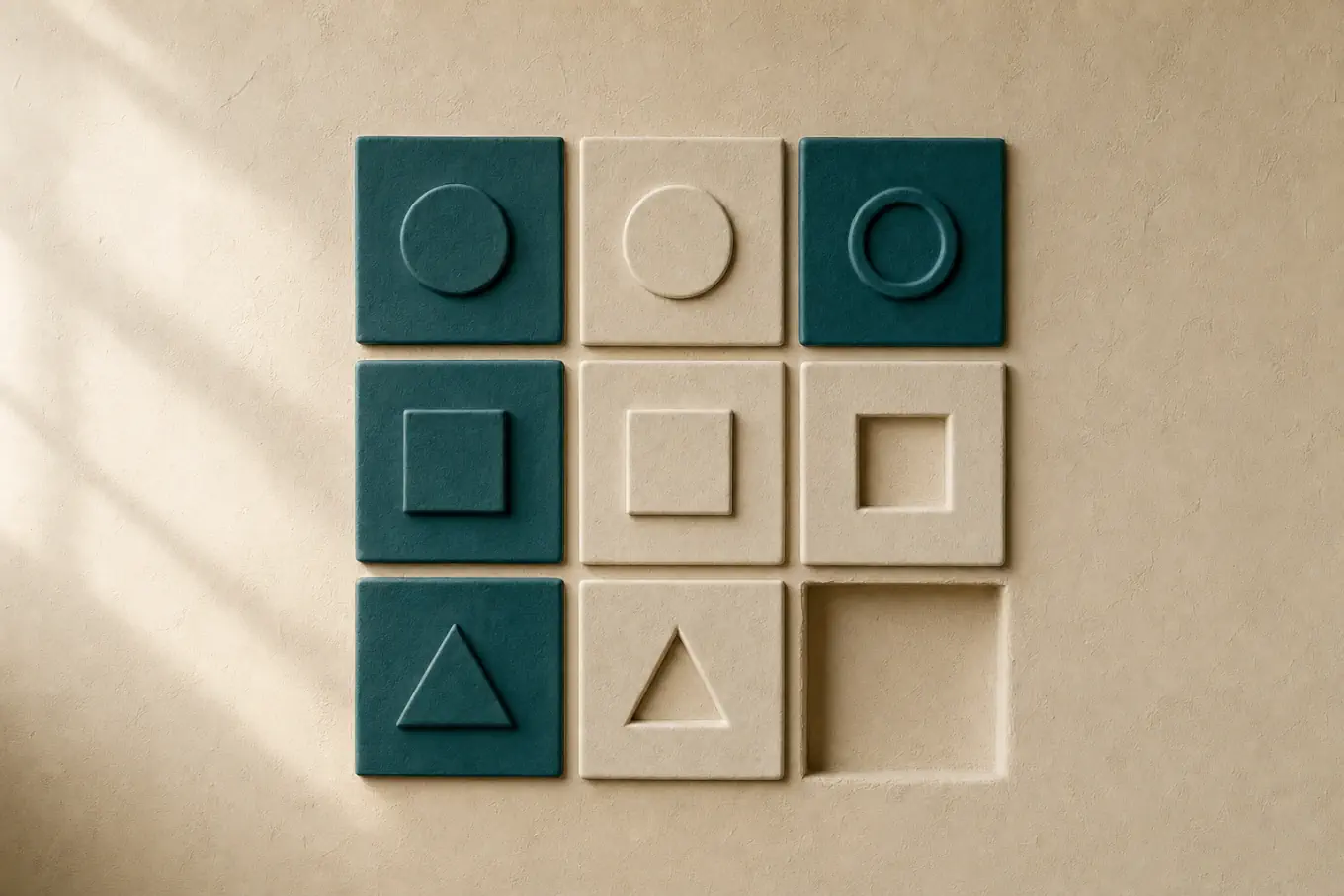
Matrix puzzles ask you to infer relationships between visual features. They can reduce some language demands, but diagrams, instructions and test familiarity can still affect performance. An online puzzle using this format does not inherit the validation of a published instrument.
Why this format dominates IQ testing
Matrix items are the closest thing psychometrics has to a culture-reduced measure of reasoning. There is no text, no arithmetic, and no knowledge to recall, so performance depends less on schooling and first language than almost any other item type. Raven's Progressive Matrices, the best-known example, has been in use since 1938 for exactly this reason.
They also load heavily on fluid intelligence, which is the ability to solve novel problems without relying on stored knowledge. That makes them the standard choice when a test needs one item type to carry as much signal as possible.
Ten of the 30 questions in our general test bank are visual items of this kind, and six of the 30 in the logical bank.
The rules matrices are built from
Nearly every matrix item is assembled from a small set of transformations. Learning the set turns the puzzle from an open search into a checklist.
| Rule | What changes | Example |
|---|---|---|
| Progression | A property increases or decreases stepwise | Fill goes solid, half, empty across a row |
| Rotation | Orientation advances by a fixed angle | An arrow turns 90 degrees per cell |
| Count | Number of elements changes | One circle, two circles, three circles |
| Constant in row | A property is fixed along the row and varies down | Every shape in row 1 is a triangle |
| Distribution of three | Three values appear once each per row and column | Each row has one solid, one half, one empty |
| Addition or subtraction | Two cells combine to make the third | Cell A plus cell B, overlapping parts removed |
Harder items combine two rules on different attributes at once. A grid might rotate shapes across the row while reducing fill down the column, so the missing cell needs both applied. Combined-rule items are where most people lose time, and recognising that two things are varying independently is most of the work.
A method that works under time pressure
Cover the options first. Answer choices on matrix items are constructed as near misses, each correct on some attributes and wrong on one, so looking at them early anchors you to a plausible wrong answer. Deriving what the missing cell must be before you look is the single biggest accuracy gain available.
Read the top row left to right and name what changes. Say it explicitly, even silently: shape stays, fill decreases. Then check whether the second row obeys the same rule, which confirms it rather than leaving it a guess.
Then read down the first column and do the same. Once you have a row rule and a column rule, apply both to the empty cell and construct the answer in your head.
Only then look at the options and find the match. If two options both fit, you have missed an attribute; go back and check size, count, orientation, and shading separately rather than looking at the figures as wholes.
A worked example
Take a three by three grid. Row one holds a solid circle, a half-filled circle, an empty circle. Row two holds a solid square, a half-filled square, an empty square. Row three holds a solid triangle, a half-filled triangle, and an empty cell.
Reading across row one: shape is constant, fill decreases from solid to half to empty. Row two confirms it with squares. Reading down column one: fill is constant at solid, shape changes from circle to square to triangle.
So the missing cell keeps row three's shape, which is a triangle, and takes column three's fill, which is empty. The answer is an empty triangle, derived without ever looking at the options. This exact item is in our general test bank.
Practising without wasting time
Start with enough examples to understand the format, then practise explaining the rules. There is no fixed first-hour benefit or guaranteed transfer to general intelligence.
Practice identifying rules rather than getting answers right. After each item, whether you got it or not, name the transformations explicitly. That habit transfers to new items; remembering that the answer to question 7 was the empty triangle does not.
Use untimed work to learn a method, then try timed practice if pacing is relevant to your goal. Compare your explanations on new items rather than memorizing answers.
Questions people also ask
Are matrix reasoning tests culture-fair?
More than verbal tests, and not entirely. They remove language and schooling content, which closes much of the gap, but familiarity with two-dimensional diagrams and with test-taking itself still varies across populations. Culture-reduced is the accurate description rather than culture-free.
What is the difference between Raven's Matrices and other matrix tests?
Raven's is a specific published instrument with established norms and a fixed progression of difficulty. Most matrix items you encounter online use the same format without the norming behind it, which affects what the resulting score means rather than how you solve the puzzles.
Keep reading
- Number Sequence Puzzles: How to Solve ThemDifferences first, then ratios, then compound rules.
- How to Prepare for an IQ TestFormat practice, pacing and the limits of repeat scores.
- Are Online IQ Tests Accurate?What separates a decent online test from a worthless one.
Continue learning
Try a free explained practice session and a seven-day plan. No purchase is required.
Start free practice Explore optional resources